

The Moisture Problem Moisture-Associated Skin Damage (MASD) is an umbrella term1, subdivided into four categories (see left).
Intertriginous dermatitis (intertrigo)
Periwound moisture-associated dermatitis
Incontinence-associated dermatitis (IAD)
Peristomal complications
The Moisture Problem
Sadly, incidence rates of MASD are as high as 29% amongst longer stay (48 hours+)2 patients in areas like critical care. However, there is also increased risk in any care setting where patients’ skin can be exposed to excess bodily fluid or moisture, for example, in community care settings, residents in nursing homes are also a particularly high-risk group, with two thirds affected by both faecal and urinary incontinence.3
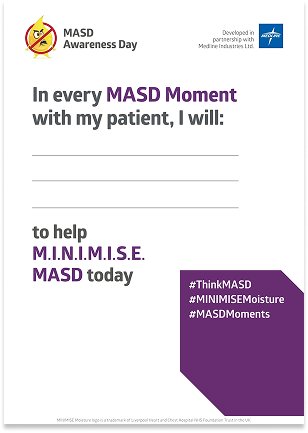
Make the Pledge!
For each MASD Moment with my patient I will…
Every member of your team, from healthcare assistants to matrons and consultants, has a role to play in preventing and managing MASD. Early identification of patients most at risk is key and implementing appropriate care plans is vital in preventing avoidable cases. Moreover effective management of MASD is important to reduce the pain and distress for patients where it has already developed.
Each pledge should aim to make a positive difference to every patient at risk of or suffering with MASD.
The 'MASD Moment'
This year’s MASD Awareness Day will focus on ‘The MASD Moment’ encouraging teams to reflect on current practice and enhance prevention and management of MASD.
Aligned with the principles set out in the Wounds UK Best Practice Statement, each “MASD Moment” with your patient should consider:

Gently cleansing the skin

Controlling moisture

Protecting the skin

Treating fungal infection

Managing associated symptoms.
Join the Webinar
When you sign up you will also be invited to an MASD Webinar in the run up to MASD Awareness Day with Julie Tyrer, at Liverpool Heart and Chest Hospital.
Title: TBD
Speaker: Julie Tyrer, Tissue Viability Nurse Consultant, Liverpool Heart and Chest Hospital
Date: Thursday, 12 March at 12.00pm (GMT)
MASD Awareness Day was inspired by the MINIMISE Moisture Quality Improvement Initiative which was developed by Tissue Viability Nurse Julie Tyrer and her team.
Since launching this day in 2022, over 200 healthcare organisations around the UK have run their own MASD Awareness Days, an educational day where both staff and patients are provided with the resources and materials to develop their knowledge to further reduce Moisture Associated Skin Damage. In our post-MASD Awareness Day survey, 97% of respondents said new knowledge learnt from their local awareness day helped improve their clinical practice.
References
- Best Practice Statement (2025) Understanding types of moisture associated skin damage (MASD): prevention, identification and management. London: Wounds UK. Available to download from: www.wounds-uk.com
- Valls-Matarín, et al. (2017). Incidence of moisture-associated skin damage in an intensive care unit, 28(1), 13–20
- Jaekel AK, Rings TM, Schmitz F, Knappe F, Tschirhart A, Winterhagen FI, Kirschner-Hermanns RKM, Knüpfer SC. Urinary and Double Incontinence in Cognitively Impaired Patients: Impacts on Those Affected and Their Professional Caregivers. J Clin Med. 2023 May 9;12(10):3352. doi: 10.3390/jcm12103352. PMID: 37240458; PMCID: PMC10219393. https://pmc.ncbi.nlm.nih.gov/articles/PMC10219393/